Hardware And Software Integration, Covering Multiple Application Scenarios
 2026-10-26
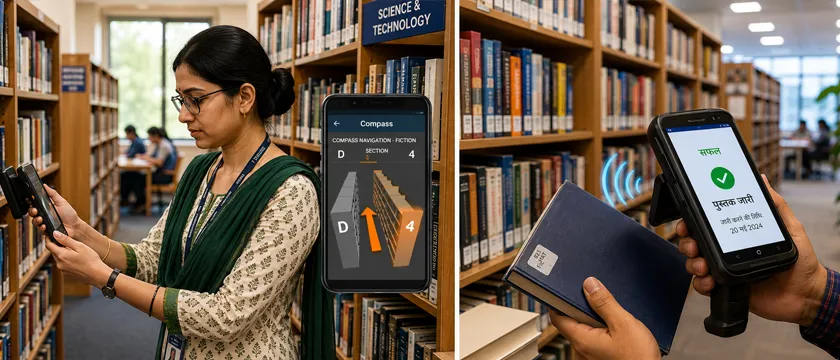
I. Case Overview
Item | Content |
Case Name | Jinan City Library "Unattended Borrowing Closed-Loop Service" (National First) |
Implementing Entity | Jinan City Library (Prefectural-level Public Library) |
Business Scale | Approximately 600,000+ volumes in collection; receives over 5 million visits annually, peak single-day visits exceeding 30,000 |
Core Pain Points | High book circulation frequency, low traditional manual inventory efficiency, frequent mis-shelving and dis-shelving; patrons had to go through multiple steps: "search terminal query → find shelf location → manual or self-checkout operation" |
Solution Composition | Three core modules: ① RFID Intelligent Cruise Inventory Device; ② 3D Virtual Library Platform; ③ Unattended Borrow/Return Channel |
Key Equipment | Cruise inventory device automatically sliding along top-of-shelf tracks, with built-in Ultra-High Frequency (UHF) RFID antenna array |
R&D Process | 2022–2024: First tried inventory robots and visual inventory technology, results not ideal; second half of 2024: joint development with a Guangzhou enterprise; 2025: successfully developed and deployed |
Key Results | ① 15 minutes completes inventory of 600,000+ volumes, accuracy 98.4%; |
Promotion Plan | Will gradually promote to more public libraries and "Quancheng Study Room" and other public cultural spaces, building a full-coverage smart reading network |
Data source: Dazhong News · Dazhong Daily "Cultural China | 6-Second Face-Swiped Borrow/Return! Jinan Creates Nation's First Unattended Borrowing Closed-Loop Service" (October 19, 2026, reporter Sun Yewen), simultaneously republished by Xinhua News Agency Shandong Channel, Sina Finance, etc. See source list at end of document.
II. Project Background: A Library Receiving 5 Million Annual Visitors, Stuck at the "Finding Books" Step
Jinan City Library receives over 5 million visits annually, peak single-day visits exceeding 30,000, with a collection of approximately 600,000+ volumes. In such a high-traffic public library, one old problem remained unsolved: patrons know the book title but can't find the book.
2.1 Traditional Borrowing Chain: Four Steps, Each Time-Consuming
Before renovation, a complete borrowing required four steps: "search terminal query → note call number → go to shelf area to find → counter or self-checkout scan per book". According to library disclosures, average patron book-finding time was 15 minutes, each borrow/return session took several minutes per person. With tens of thousands of daily visitors, this time was amplified into persistent queuing and crowding.
2.2 Library Management Side: Three Nationwide Common Challenges
1. Low inventory efficiency: High book circulation frequency means book locations change daily; manual inventory is always "yesterday's data".
2. Mis-shelving and dis-shelving: Patrons place books randomly after reading, frequent mis-shelving and dis-shelving mean the next patron goes to the location shown by the system but finds nothing.
3. Labor entrapment: Basic work like inventory, shelf arrangement, and shelf straightening consumes massive labor, trapping staff in low-value repetitive work.
Zhao Xibo, Director of the Network Information Department at Jinan City Library, explicitly stated in the report: "High book circulation frequency, low traditional manual inventory efficiency, and frequent mis-shelving and dis-shelving have become common challenges plaguing libraries nationwide." This sentence points to the project's real value — it's not solving one library's problem, but testing a route that all national peers can take.
2.3 Two Technical Trial Errors: Why the First Two Routes Didn't Work
Notably, Jinan Library didn't start with the right solution. From 2022 to 2024, they tried two popular technical routes, both with unsatisfactory results:
• Inventory Robot: Needed to solve ground navigation, obstacle avoidance, and docking precision issues; actual performance in dense shelf areas did not meet expectations.
• Visual Inventory: Relied on cameras to recognize spine images; recognition rate was unstable when encountering occlusion, lighting changes, dense arrangement, and similar-looking spines.
The "intelligent shelf" solution — embedding antenna arrays in each shelf layer board for real-time on-shelf monitoring — had the best results but was blocked by cost: the high renovation cost made the library hesitate.
So the question was redefined: Is there a device that works well and is also cheap enough? This framing ultimately determined the solution's form.
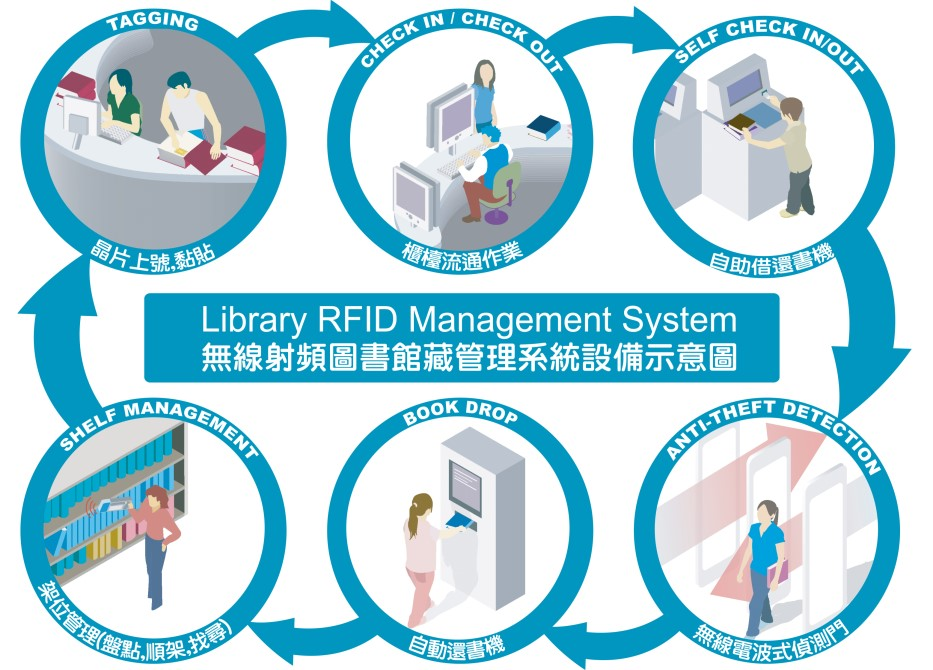
III. Technical Solution: Unattended Borrowing Closed-Loop Composed of Three Modules
The entire service is interlocked by three modules, solving three things respectively: "countable", "findable", "borrowable fast" — together forming a full closed-loop from inventory to borrow/return.
3.1 Product Layer: Each Book Has a UHF Electronic ID
• Tag Specification: Operating frequency 860–960 MHz, protocol ISO 18000-6C / EPC Gen2, compatible with UHF general reader ecosystem.
• Data Content: Tag contains book ID, call number, etc., mapped to MARC records in the Library Management System (ILS).
• Selection Key Points: Thin tags suitable for inside cover or spine placement; metal shelves and compact shelving environments require attention to antenna detuning, shelf tags can use metal-resistant packaging.
3.2 Collection Layer: RFID Intelligent Cruise Inventory Device (Core Innovation of This Solution)
This is the most noteworthy engineering innovation in the entire project. It didn't follow the traditional approaches of "person carrying device walking" or "each shelf layer installing antennas", but took a third route:
• Track-Based Movement: Tracks laid on top of bookshelves, inventory device automatically slides along tracks daily, no manual pushing needed.
• UHF Antenna Array: Inventory device has built-in UHF RFID antenna array, batch-collects book tags on both sides of shelves while sliding.
• Efficiency Result: 15 minutes to complete data collection and update for 600,000+ volumes, accuracy 98.4%.
• Cost Structure: Overall cost only 3% of intelligent shelf solution — because cost focus shifted from "one antenna per layer" to "one track + one mobile device".
This design approach deserves separate highlighting: intelligent shelves are expensive due to coverage density (need to cover every layer), cruise solutions are inexpensive due to one-time infrastructure (tracks). The larger the collection, the more linear the former's cost rises, the more the latter is amortized — this is why it can achieve a 30x cost difference at the 600,000 volume scale.
3.3 Location Layer: 3D Virtual Library Platform
Inventory data is limited in value if it only says "a book is in the library"; Jinan Library turned it into navigation capability.
• 3D Modeling: 1:1 3D modeling of borrowing area, stereoscopically restored spatial layout, down to each bookshelf and each layer shelf board.
• Precise Location: Patrons click "Virtual Navigation" in WeChat Service Account "Micro Service Hall", enter book title, system returns position and distance precise to "North 1 Area, Shelf 11, Side B, Column 12, Layer 05 on 2nd Floor, 18.83 meters to destination", and plans optimal route.
• Closed-Loop Effect: System doesn't only tell you if a book is in the library — it marks exact location on 3D map, total time from searching to finding approximately 2 minutes.
3.4 Circulation Layer: Unattended Borrow/Return Channel
• Actual Experience: Patron carries 6 books directly through channel, one face-swipe completes borrowing, total 6 seconds.
• Technical Action: During book borrow/return, system instantaneously completes association and disassociation of patron identity and book information, no per-book operation needed.
• Additional Value: Channel simultaneously handles anti-theft function, triggers alarm when un-checked-out books pass through.
3.5 Platform Layer: Integration with Existing Systems
• System Integration: API integration with Library Management System (ILS), completes RFID encoding and MARC record data field mapping.
• Patron Entry: Patron-facing entry is WeChat Service Account, no standalone app installation needed, lowering usage barrier.
• Data Connectivity: Data from five processes — inventory, search, location, navigation, borrow/return — connected on the same platform; this is the meaning of the word "closed-loop".
IV. Route Debate: Why Libraries Started Using UHF Instead of Traditional HF
Libraries are one of the earliest industries worldwide to adopt RFID at scale, but the mainstream has long been HF (13.56 MHz) solutions, typified by ISO 15693 standard book tags. Jinan Library chose UHF (Ultra-High Frequency) as the core for inventory and channel — this is a representative route selection. The real differences between the two frequency bands are as follows:
Comparison Dimension | HF (13.56 MHz) | UHF (860–960 MHz) |
Mainstream Standard | ISO 15693 / ISO 18000-3 | ISO 18000-6C / EPC Gen2 |
Reading Distance | Near-field, typically 30–60 cm, generally not exceeding 1 m | Far-field, with antenna can reach several to over ten meters |
Batch Reading | Limited capability, usually per-book or small quantity recognition | Can read hundreds of tags per second, suitable for dense batch collection |
Single Tag Cost | Relatively high | Relatively low, significant cost advantage for large-scale deployment |
Body/Liquid Impact | Less impact, good stability | More noticeably affected, needs compensation through deployment and algorithms |
Position Boundary Clarity | Near-field boundary clear, checkout counter less likely to misread adjacent books | Far-field prone to cross-reading adjacent shelves, needs power control and RSSI filtering |
Anti-Theft and Access Control | Mature, low false alarm rate | Channel gates mature, industry-caliber false alarm rate can be below 0.1% |
Typical Division of Labor | Dominates precise association scenarios like self-checkout counters | Dominates batch collection scenarios like inventory, cruise, channel gates |
The tradeoffs in Jinan's solution are clear: place UHF in its two strongest positions — batch inventory and channel gates — while using the 3D virtual library platform to compensate for UHF's inherent shortcoming in single-item positioning precision, and using multi-antenna deployment at channel gates to counter body and occlusion effects. This is not "UHF completely replaces HF", but an engineering judgment of "frequency by scenario". For equipment suppliers, this judgment itself is excellent sales language: don't argue with customers about which frequency band is better — tell them where each frequency band should be used.
V. Four Inventory Technology Route Comparison: Why Jinan Finally Chose the Cruise Solution
Jinan Library actually trialed two routes between 2022–2024; the "measured evaluation" in this comparison table is not extrapolation but conclusions publicly stated by the library.
Technical Route | Basic Principle | Advantages | Limitations | Jinan Library Measured Evaluation |
Intelligent Shelf | Antenna arrays embedded in each shelf layer board, real-time on-shelf status monitoring | Highest precision, can do real-time in-place monitoring | High renovation cost, cost grows linearly with shelf count | Good effect but too expensive, had to pass |
Inventory Robot | Wheeled / AGV robot carrying reader to patrol shelves | High automation, no shelf renovation needed | Ground navigation, obstacle avoidance, docking precision limitations | Trialed 2022–2024, result not ideal |
Visual Inventory | Camera + AI recognition of spine images | No need to tag each book | Affected by occlusion, lighting, dense arrangement, identical-looking spines | Trialed 2022–2024, result not ideal |
Cruise Inventory Device (This Solution) | Tracks laid on top of bookshelves, mobile inventory device carries UHF antenna array to slide and collect | 15 minutes / 600,000+ volumes, accuracy 98.4%, overall cost only 3% of intelligent shelf | Requires one-time track renovation; dependent on tag coverage | Joint developed second half 2024, deployed 2025 |
VI. Patron Perspective: Before vs After Renovation
Process | Before Renovation | After Renovation |
Search | Go to search terminal to query, note call number | WeChat Service Account "Micro Service Hall" query anytime, anywhere |
Find Book | Find by call number in shelf area on your own, average 15 minutes | 3D virtual navigation real-time guidance, shows specific shelf/column/layer and remaining distance (e.g. "18.83 meters to destination") |
Get Book | Manual searching, often empty-handed due to mis-shelving | System shows in-library status and precise location, average finding time 3 minutes |
Check Out | Go to counter or self-checkout to scan each book, takes several minutes per person | Carry 6 books directly through unattended borrow/return channel, face-swipe completes in 6 seconds |
Return | Counter manual processing or self-checkout per-book operation | Instant identity-book information disassociation in channel |
Overall Experience | Many steps, time-consuming, queuing at peak hours | Approximately 2 minutes from searching to finding book, service satisfaction above 98% |
VII. Implementation Results
7.1 Publicly Measured Data from This Project (Jinan City Library)
Indicator | Before Renovation | After Renovation |
Single Full-Library Inventory Time | Manual periodic inventory, low efficiency (specific duration not disclosed) | 15 minutes completes 600,000+ volumes |
Inventory Accuracy | — | 98.4% |
Average Patron Book-Finding Time | 15 minutes | 3 minutes |
Borrow/Return Time | Several minutes per person | Several seconds (6 books face-swipe in 6 seconds) |
From Searching to Finding Book | Far exceeds 15 minutes | Approximately 2 minutes |
Patron Service Satisfaction | — | Above 98% |
Overall Solution Cost | Using intelligent shelf solution as baseline (100%) | Approximately 3% |
Basic Organizing Labor | Large labor input for inventory and shelf arrangement | Only a few people needed for simple book organizing |
All above data comes from public statements by library officials (Network Information Department Director Zhao Xibo and staff Ma Zhengwei) in Dazhong Daily reports.
7.2 Industry Quantitative Reference (Not This Project's Data, For Magnitude Judgment Only)
The following table data comes from other library projects and industry media calibers, has no direct relationship with the Jinan project. When citing, please note respective sources and do not mix with this case:
Indicator | Before | After | Source and Caliber |
Annual Inventory Time (approximately 100,000 volumes) | Approximately 3 weeks | Approximately 3 hours, efficiency improved over 90% | Chainway public case: a domestic Chinese library, approximately 100,000 volume collection, using UHF handheld + desktop reader |
Full-Library Inventory Time (100,000 volume level) | 1 month | 4 hours | RFID World industry caliber, no specific library name noted |
Inventory Labor Efficiency | 3 people / week | 1 person / hour | RFID World industry caliber, no specific library name noted |
Mis-Shelving Rate | 8% | 0.5% (circulation rate increased 35%) | National University of Singapore Library, relayed by industry media, no original report seen, suggest cautious citation |
Average Patron Borrowing Time | 3 minutes | 20 seconds (annual labor cost savings RMB 2 million+) | National Library of China, relayed by industry media, no original report seen, suggest cautious citation |
Borrow Time / Redundant Labor Hours / Loss Rate | 3.2 min / 31 h wk / 4.7% | 0.9 min / 11 h wk / 0.3% | RFIDHY vendor case (a polytechnic institute library 2023 annual report caliber), not independently verified |
Anti-Theft False Alarm Rate | Traditional magnetic strip | Below 0.1% | RFID World industry caliber |
Self-Checkout Batch Recognition | Per-book barcode scanning | ≤10 books recognized at once, completed within 2 seconds | RFID World industry caliber |
Note: The "National Library of China" and "National University of Singapore" data groups in the above table are widely relayed in Chinese industry media, but no original source reports were found. When proposing externally, it is recommended to mark as "industry reference" rather than "measured".
VIII. Hardware Configuration List (General Suggestions, Replaceable with Your Company Models)
Jinan Library's official information did not disclose specific equipment models and procurement lists. The following table provides general configuration suggestions for similar UHF smart library projects, can serve as reference framework for quotation and selection:
Category | Specification Suggestion | Deployment Location / Usage | Your Company Corresponding Product |
UHF Book Tag | 860–960 MHz, EPC Gen2; thin 25×25 mm or long-strip 95×8 mm; EPC area 96–128 bits, supports user area writing of call number | One per book, pasted inside cover or spine | UHF Book-Specific Tag |
UHF Shelf Tag | Metal-resistant packaging preferred, handles metal shelf boards and compact shelving environments | One per shelf level, records level coordinates for inventory location | Metal-Resistant Tag Series (e.g. OPP130 type) |
Cruise Inventory Device | Track-based mobile platform + UHF antenna array + multi-channel reader module | Top-of-shelf track, automatic daily shelf-patrol collection | Multi-Channel Fixed Reader + Custom Antenna Array |
Fixed Reader | Four-channel, supports dense read mode and RSSI filtering, Ethernet/PoE powered | Unattended borrow/return channel, entrance/exit access control | Four-Channel Fixed UHF Reader |
Channel Gate Antenna | Circularly or dual-polarized, gain 6–9 dBi, paired deployment to form coverage area | Both sides of borrow/return channel, handles both identification and anti-theft alarm | UHF Channel Gate Antenna |
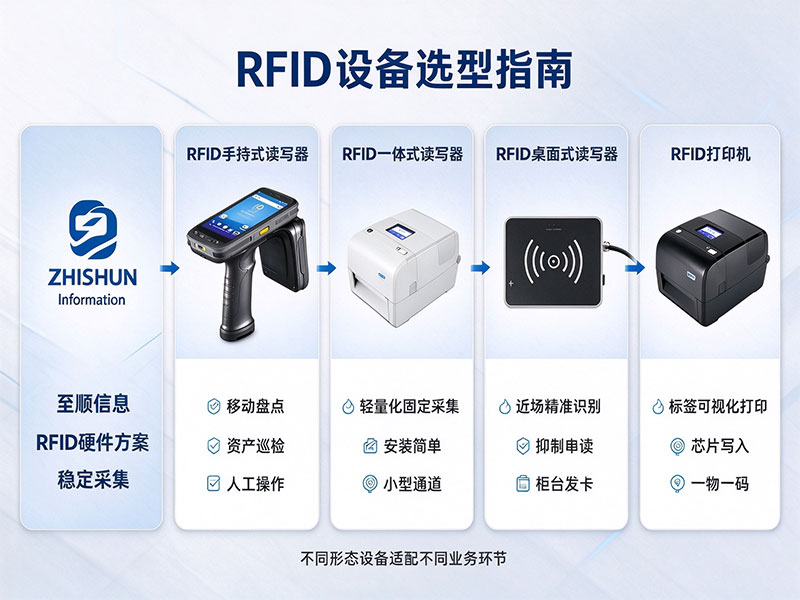
Self-Checkout Terminal Reader | Near-field / short-range read, controllable reading distance, avoids misreading adjacent books | In-library self-checkout machines | Desktop / Embedded UHF Reader |
UHF Handheld Device | Read rate above 200 tags/sec, supports RSSI strength positioning (book-finding mode) | Supplemental inventory, mis-shelving verification, patron request book-finding | UHF Handheld Reader |
Tag Encoding Station / Printer | Supports batch encoding and barcode synchronous verification | Acquisition/processing stage, new book tagging and data binding on entry | UHF Tag Printer / Encoding Station |
Middleware and Platform | Provides REST/SOAP API, integrates with ILS (Wenxian, ILAS, etc.), supports MARC field mapping, 3D visualization, navigation service | Local server or private cloud deployment | Library RFID Management Platform |
IX. Pitfall Avoidance Guide: Nine Key Control Points for Library UHF Projects
1. Encoding specification first: Tag encoding standards must be set before starting work. RFID encoding and MARC record field mapping rules must be determined before tagging; otherwise, re-encoding after 600,000 volumes are tagged is an unacceptable cost.
2. Distinguish two types of tags: Thin regular UHF tags are fine for books; shelf tags, because they are pasted on metal layer boards, must use metal-resistant packaging — otherwise detuning results in unreadable tags. This is the only direct metal-resistant tag related part in this project.
3. Unified placement position: Reading consistency differs significantly between inside cover and spine placement; must unify across the entire library and model inventory algorithms around the unified position.
4. Cross-read control: UHF far-field advantage is also a risk — easy to read books from adjacent shelves. Must suppress through reducing transmit power, RSSI threshold filtering, antenna polarization direction design.
5. Precise borrow/return association: Self-checkout counter requires "what's read must be this book on the counter" — UHF far-field is at a disadvantage here. Recommend near-field / short-range antennas with physical shielding on the counter, or keep HF for this step.
6. Body and occlusion: When patrons carry books through the channel, tags are blocked by arms and body. Channel gates must use multi-antenna, multi-angle deployment, and test with real people — don't only test with empty channels.
7. Accuracy expectation management: Inventory accuracy of 98.4% means still approximately 1.6% missed or misread — need to design supplemental inventory process (second verification with handheld devices), don't let staff have unrealistic expectations about the numbers.
8. Privacy compliance: Borrow/return records linked to face information involves personal information protection compliance. Need explicit notice, minimize collection, desensitize borrowing history — public libraries are particularly sensitive to this.
9. Pilot first, then scale: Jinan Library also spent two years of trial and error before finding the solution. New libraries are advised to start with one or two borrowing zones as pilot, run through inventory-location-borrow/return closed-loop before full-library rollout.
X. Replicability and Promotion Prospects
10.1 What Kind of Libraries Does This Solution Suit
• Scale Threshold: The larger the collection, the more obvious the cruise solution's cost advantage over intelligent shelves (cost focus is track infrastructure, amortized by scale).
• Spatial Condition: Bookshelf top has conditions for track laying, or can accept one-time track renovation.
• Pain Point Intensity: Mis-shelving, dis-shelving, hard-to-find books are already concentrated points of patron complaint, sufficient renovation motivation.
• IT Infrastructure: Already has basic ILS system and network environment, capable of API integration.
10.2 Next Steps for Jinan Library
According to library statements, in the future the unattended borrowing technology will be gradually promoted to more public libraries, Quancheng Study Room and other public cultural spaces, building a full-coverage smart reading network. This means this solution has moved from "single library pilot" to "regional replication" phase — for equipment suppliers, this is a market window opening up that can be batch-replicated.
10.3 Three Inspirations for Solution Providers
• Sell experience rather than equipment: What customers are really buying is not readers, but perceptible experience improvements like "patron book-finding time reduced from 15 minutes to 3 minutes".
• Cost narrative first: Jinan Library was deterred by intelligent shelf cost and impressed by the cruise solution's 3% cost — in public cultural sectors, cost structure persuasion often outweighs performance parameters.
• Acknowledge competitor boundaries: Customers may have already trial-errored with robot and visual solutions, coming with failed experience. Proactively clarify each route's boundaries — easier to build trust than merely pushing your own product.
XI. Data Sources and Citation Notes
1. Dazhong News · Dazhong Daily "Cultural China | 6-Second Face-Swiped Borrow/Return! Jinan Creates Nation's First Unattended Borrowing Closed-Loop Service", reporter Sun Yewen, October 19, 2026. Xinhua News Agency Shandong Channel, Sina Finance, Sohu simultaneously republished. (Core data source for this case, including 600,000+ volumes, 15 minutes, 98.4%, 3% cost, 15→3 minute book-finding, 6-second borrow/return, 98% satisfaction, 2022–2024 trial process, etc.)
2. RFID World "Library Management Revolution: How UHF RFID Tags Achieve Second-Level Borrow/Return, Zero-Error Inventory", 2025. (Industry quantitative reference data in Section 7.2 marked as this caliber)
3. Chainway official website case "RFID Library Management in China" (approximately 100,000 volume collection, annual inventory reduced from 3 weeks to 3 hours)
4. GAO RFID, RFIDHY and other supplier public cases (mis-shelving rate, inventory efficiency and other reference data, mostly supplier self-reported caliber, not cited in this document body)
Citation Note: Main case data of this document (Section 7.1) comes from authoritative media direct interviews with the library, directly citable externally; Section 7.2 is industry quantitative reference, has no direct relationship with Jinan project. When proposing externally, must list as separate tables, and note respective sources and calibers to avoid being questioned by professional customers.

Scan To Add

Scan To Add
Copyright © 2026 Shenzhen Zhishun Information Technology Co., Ltd All Rights Reserved.
Technical Support:SYSX





 182-7997-4925

 Home