Hardware And Software Integration, Covering Multiple Application Scenarios
 2026-10-26
I. Case Overview
Item | Content |
Case Name | Mini Smart Ahonkylä (Unmanned Convenience Store in Ahonkylä Village, Finland) |
Implementation Time / Location | Opened in 2022 · Ahonkylä Village, Finland (approximately 2,000 permanent residents) |
Business Model | 24/7 unattended operation, no cashiers or staff on-site, only periodic restocking |
Operating Scale | Approximately 800 food and beverage SKUs (milk, bread, coffee, carbonated drinks, etc.) |
Core RFID Hardware | Nordic ID AR85 Fixed UHF Reader (checkout counter / exit gate), |
Tagging Solution | Confidex Ferrowave Flag Metal-resistant / Liquid-resistant UHF Tags (individual tagging for all products) |
Software Platform | Nordic ID RADEA Cloud Software (inventory / sales / shelf-life) + Seita Technologies Payment System |
Payment Method | Bank cards (debit / credit), automatic deduction after confirmation on checkout touchscreen |
Key Results | ① 24/7 non-stop operation, covering rural markets that traditional stores cannot sustain; |
Source: RFID Journal "RFID Enables Self-Service Unmanned Stores in Rural Finland" (case facts section).
II. Project Background: A Village That "Can't Afford" Store Staff
Ahonkylä is a village of about 2,000 people in Finland, located beside a major road with some commuter and passing traffic. The problem: the population is too small to support the fixed labor costs of a traditional staffed convenience store, and villagers have long lacked nearby channels for daily purchases (especially at night and early morning). Local resident Petri Jaakola wanted to solve this pain point — the demand is real, but the cost model of traditional convenience stores doesn't work.
This is exactly the typical applicable scenario for UHF RFID unmanned retail:
• Cost structure imbalance —— labor costs are too high, the decisive variable for store viability;
• Time window mismatch —— small customer flow but rigid demand, can be activated with 24-hour operation;
• Product structure fit —— limited SKU count, mainly packaged food and beverages, individual tagging workload is manageable.
The result is a store that opened in 2022 with round-the-clock automated operation, turning an "unprofitable store" into a sustainable business, and proven to be replicable in other remote areas.
III. Technical Solution: Four-Layer Architecture Breakdown
3.1 Product Layer: A "Digital ID" for Every Product
Every product in the store is attached with a UHF RFID tag, with a globally unique ID written into the tag and bound to backend SKU data. Since products are mainly food and beverages with complex packaging forms (metal cans, Tetra Pak, glass bottles, plastic bottles), the project selected Confidex Ferrowave Flag tags — their flag-shaped structure can be directly attached to metal packaging and liquid containers, surfaces that are difficult for traditional RFID to read, avoiding missed reads due to packaging materials.
3.2 Perception Layer: Dual Nodes of Checkout Counter + Exit Gate
Deployment Location | Equipment | Function |
Entrance | Nordic ID Sampo S2 NFC Reader | Swipe bank card for identity recognition, door opens automatically after verification, real-name controllable |
Checkout Counter | Nordic ID AR85 UHF Fixed Reader + Antenna | Read all product tags on the counter at once, generate bill |
Exit | Nordic ID AR85 UHF Fixed Reader | Secondary read when leaving, compare with paid list, intercept unpaid items |
Whole Store (Mobile) | Nordic ID HH83 Handheld Terminal | Stock-in association, inventory, item finding, shelf-life inspection |
Backend | Nordic ID RADEA Cloud Software + Seita Payment | Inventory / sales / shelf-life management, payment integration |
3.3 Encoding Layer: Encode on Stock-In, 10 Tags at a Time
Products arrive at the store untagged. An encoding workstation is set up in the store: employees place 10 blank tags on the encoding station, batch-write and associate product information through RADEA software; individual items are associated one-to-one using the HH83 handheld device. This step transforms "tagging" from a per-item operation to batch processing, key to controlling deployment costs.
3.4 Platform Layer: Data-Driven Dynamic Operations
• Automated inventory count —— real-time inventory visibility, automatic out-of-stock alerts and restocking triggers;
• Shelf-life management —— record shelf-life of each batch, automatic discounts for near-expiry, direct sales prohibition for expired;
• Item-level traceability —— unique tag ID makes the purchase, sale, and inventory of every product traceable.
IV. User Journey: From Entry to Exit
1. Identity Entry—— Customers swipe their debit/credit card at the entrance, the NFC reader completes identity recognition, and the door unlocks automatically.
2. Free Shopping —— Shop freely, no scanning, no queuing.
3. Batch Checkout —— Place products on the checkout counter, the UHF reader reads all tags at once (non-line-of-sight, can penetrate packaging), and the touchscreen lists the product list.
4. Confirm Payment —— Customer confirms the list on the touchscreen, and the system completes payment automatically.
5. Exit Verification —— Customer presses the door button, the exit reader reads all tags again and compares with the paid list: if all match, the door opens; if unpaid items are detected, the screen prompts the customer to return to checkout.
Throughout the process there are no cashiers, no queues, no per-item scanning — "grab and go" is achieved through the batch reading capability of the hardware layer, not visual inference from cameras.
V. Implementation Results
5.1 Operational Capabilities Achieved by This Project (Case Facts)
Dimension | Implementation Result |
Operating Hours | 7×24 non-stop, no on-site staff, only periodic restocking personnel needed |
Product Variety | Approximately 800 food and beverage SKUs, operations supported by technology rather than labor |
Inventory Management | Automated inventory counting, automatic restocking alerts when out of stock, farewell to manual inventory |
Loss Control | Exit reader secondary verification, unpaid items intercepted; system can identify unpaid removal behavior |
Shelf-life Management | Automatic discounts for near-expiry, sales prohibition for expired, directly reducing food waste losses |
Replicability | Proven replicable and scalable to other remote / challenging areas |
5.2 Industry-Level Quantitative Reference (Not Measured Data from This Project)
The following are industry statistics and third-party research data, used to estimate input-output of similar projects. Different calibers should not be directly mixed with this case:
Indicator | Traditional Stores / Without RFID Deployment | After UHF RFID Deployment | Data Source |
Product Shrinkage Rate | 3.5% – 5% (beverage category) | Reduced to below 0.8% | Checkpoint Systems "2022 Retail Loss Prevention Report" |
Unmanned Store Overall Shrinkage Rate | Industry average 4.7% | Compressed to 0.9%, gross profit increased by approximately 23% | China Chain Store & Franchise Association (CCFA) 2025 Data |
Inventory Accuracy | Manual inventory approximately 70% – 85% | Above 99.9% | Public data on large-scale RFID deployment in retail |
Checkout Efficiency | Self-checkout approximately 60 seconds/transaction | Full cart-level scanning approximately 12 seconds/transaction | Walmart Arkansas RFID Checkout Pilot (media report) |
Unmanned Store Per-Store Investment | — | RFID system initial investment approximately RMB 187,000, static payback period approximately 14.2 months | RFID World 2025 Industry Estimate |
Passive UHF Tag Unit Price | 2020 approximately RMB 0.321/piece | 2025 approximately RMB 0.137/piece, decrease of 57.3% | RFID World 2025 Industry Estimate |
VI. Why UHF RFID, Not Computer Vision or Weight Sensing
Comparison Dimension | UHF RFID | Computer Vision | Weight Sensing |
Recognition Principle | Radio frequency signal reads unique item ID | Camera + AI image recognition | Shelf weight change inference |
Accuracy | 99.9% level, unaffected by occlusion | Affected by occlusion, lighting, similar packaging; misjudgments require manual appeals | Adjacent product confusion, stacking misjudgment |
Batch Reading | Supports reading hundreds of tags at once, non-line-of-sight | Requires per-field-of-view recognition | Only senses weight, does not identify individual items |
Metal / Liquid Packaging | Solved with metal-resistant, liquid-resistant tags | No impact | No impact |
Deployment Cost | Low (tag unit price has dropped to RMB 0.14 level) | High (dense cameras + computing power) | Medium (dedicated shelves) |
Daily Operations & Maintenance | Low: handheld device completes full-store inventory in over ten minutes | High: algorithm models require continuous iteration | High: shelves require regular calibration |
Item-Level Traceability | Supported, enables shelf-life / anti-theft / anti-diversion | Not supported (only recognizes category actions) | Not supported |
Applicable Scenarios | Convenience stores / cabinets / stores with limited SKUs and standardized packaging | Fresh bulk, high-frequency large customer flow stores | Standardized shelves, low-value products |
VII. Deployable Hardware Configuration List (Reference BOM)
Based on a similar unmanned convenience store of 50–80 ㎡ with approximately 800–1,500 SKUs as the reference configuration:
Equipment Category | Specification Recommendation | Reference Quantity | Usage |
Four-Channel UHF Fixed Reader | Supports EPC C1G2 / ISO18000-6C, 4 antenna ports, dense reading anti-collision | 2–3 units | Checkout counter batch reading, exit anti-theft verification |
UHF Circularly Polarized Antenna | 8–9 dBi, near-field / far-field selected by scenario | 4–8 units | Covers checkout area and exit passage, eliminates blind spots |
UHF Metal-Resistant Tag | 130×42mm level, IP67, -40℃ ~ +100℃, metal surface reading distance above 20m | Configured by metal / canned SKUs | Metal packaging, canned beverages, shelf metal surfaces |
UHF Self-Adhesive Tag (General) | Alien Higgs-9 or equivalent chip, EPC 96–496 bits | Configured by SKU inventory quantity | Paper boxes, plastic bottles and other conventional packaging |
UHF Handheld Terminal | Android system, group reading ≥ 200 tags/s, supports inventory app | 1–2 units | Stock-in association, daily inventory, shelf-life inspection, item finding |
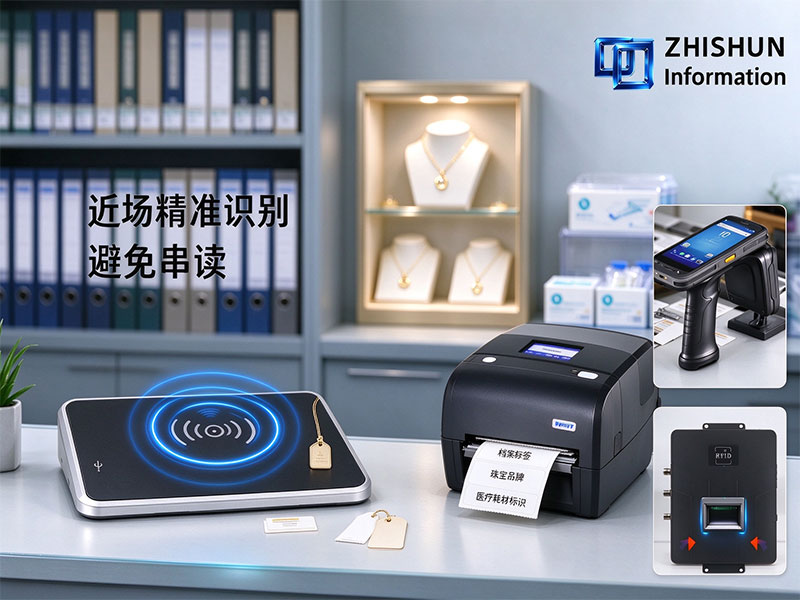
RFID Tag Printer | Industrial grade, supports UHF tag write verification (automatically detects defective tags after printing) | 1 unit | Stock-in tag printing and encoding, avoids defective tags entering circulation |
Encoding Workstation | Near-field antenna + encoding software, supports batch writing | 1 set | Batch association of blank tags with product information |
Identity Recognition / Access Control | NFC reader or QR code recognition + electric lock | 1 set | Real-name entry, controls entry crowd |
Checkout Terminal | Touchscreen all-in-one + payment module (bank card / mobile payment) | 1 unit | Bill display and confirmation, automatic deduction |
Backend Software | Inventory, sales, shelf-life, anti-theft, restocking alert modules | 1 set | Full-link data management and operational decision-making |
VIII. Implementation Key Points: Five Most Common Pitfalls
1. Tag Selection —— Use liquid-resistant tags for liquids, metal-resistant tags for metal packaging (ceramic / PET substrate), and low-temperature-resistant tags for frozen products. The read rate of ordinary tags on liquid and metal surfaces may be below 50%.
2. Cross-Read Interference —— When shelf spacing is less than 30cm, use anti-cross-read antennas or reduce reading power, otherwise adjacent shelf products may be mistakenly scanned.
3. Double Charging —— Set up an electromagnetic buffer zone in the checkout area to avoid paid products being charged again at the exit.
4. Validate Before Scaling —— First use a narrow passage for small-scale validation, test missed-read and misread rates to acceptable range (recommended ≥ 99.5%) before rolling out store-wide.
5. Data Security and Loss —— Tag data is recommended to use encrypted chips to avoid price tampering losses; tagging loss (damage, misapplication) typically accounts for about 3% of purchase volume, budget needs extra allowance.
IX. Similar Extended Cases
Case | Location / Time | Solution Highlights | Public Results |
Robomart Autonomous Mobile Store | California, USA, pilot since 2021 | App call, unmanned vehicle arrives within 10 minutes; in-vehicle UHF RFID reader reads passive tags in real-time, automatic checkout when leaving; in 2024, co-founded Autonomous Retail Collective with Avery Dennison Smartrac and others | 90% repurchase rate, average 2.3 orders per week |
Walmart RFID Checkout Pilot | Arkansas, USA, July 2025 | UHF RAIN RFID tags (consumer electronics / home category), full-cart scanning, self-service terminal automatic payment | Average transaction 12 seconds/person, about 1/5 of regular self-checkout; inventory accuracy 99.3% |
Hema Fresh RFID Fast Lane | China | Products tagged with UHF tags, exit passage automatically identifies and deducts | Achieved fast checkout lane, reduced queuing |
Hong Kong Runwu Convenience Store | Hong Kong, China | Unmanned supermarket serving student apartments, Shenzhen RAKINDA provides complete RFID unmanned retail solution | Solved late-night shopping pain point, verified solution stability and economy |
Campus / Park Unmanned Supermarket | Mainland China | Four-channel UHF reader + circularly polarized antenna + metal-resistant tags + handheld inventory device | 50 ㎡ store renovation cost can be controlled within RMB 30,000 |
Note: Walmart pilot data comes from industry media reports, not yet officially confirmed by Walmart. It is recommended to note the caliber when citing.
X. Conclusion
The value of Mini Smart Ahonkylä lies not in flashy technology, but in proving a business proposition: when labor costs are replaced by hardware costs, the store model that originally "can't afford staff" becomes viable. UHF RFID plays the most basic and critical role — giving every product a digital identity that can be recognized in batch, non-line-of-sight, and item-level manner, thereby automating checkout, inventory, anti-theft, and shelf-life simultaneously.
For retail customers preparing to replicate this model, the path is already clear: first test missed-read and misread rates in one passage to an acceptable range, then supplement metal-resistant / liquid-resistant / low-temperature-resistant tags according to SKU structure, and finally use backend data to drive restocking and shelf-life management. The technology itself is mature enough; success or failure depends on three details: tag selection, antenna layout, and business process.

Scan To Add

Scan To Add
Copyright © 2026 Shenzhen Zhishun Information Technology Co., Ltd All Rights Reserved.
Technical Support:SYSX





 182-7997-4925

 Home