Rfid Technology Empowers Various Industries
 2026-11-11
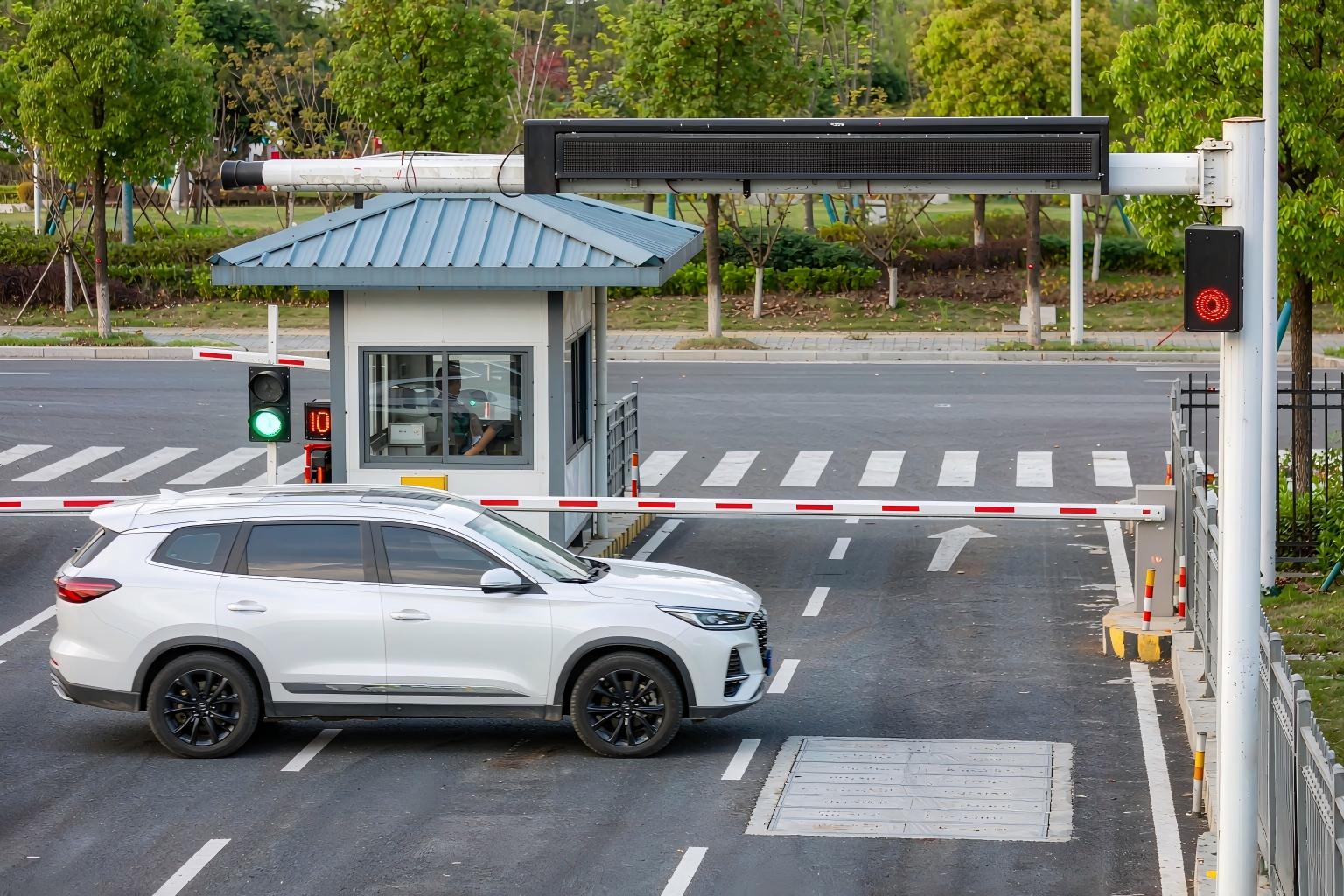
Fig. 1 — An overhead UHF reader identifies each vehicle as it approaches the gate; the barrier opens before the car stops rolling.
UHF RFID vehicle management replaces manual vehicle checks with automatic, tamper-resistant identification. A passive windshield tag is read at 8–12 m with no stopping, no line of sight and no driver action — and the same vehicle identity then drives access control, parking, fueling and maintenance.
Headline outcomes observed across deployments:
• Gate throughput: 2–4× more vehicles per lane per hour — identification completes in under 1 second at speeds up to 40 km/h
• Read accuracy: ≥ 99.9% per lane with tuned antennas (vs. ~85–92% for card-tap systems)
• Parking revenue leakage: near zero with tag-based billing linked to entry/exit timestamps
• Fuel and maintenance cost control: 8–15% reduction once every liter and work order is tied to a verified vehicle ID
• Audit trail: 100% automatic entry/exit logs — vehicle, lane, timestamp — retained for years
Typical payback for a 2-gate, 500-vehicle campus is 10–16 months; access-control-only sites typically see 16–24 months. A detailed ROI model is provided in Section 11.
A single guard verifying a pass visually takes 15–40 seconds per vehicle; at morning rush this produces queues of dozens of cars plus inconsistent enforcement — and neither event is recorded.
Proximity cards force drivers to stop and tap; credentials are shared and cloned because they are not bound to the vehicle.
Without per-vehicle identity, operators cannot reliably bill visitors, prevent monthly-pass sharing, or guide drivers to free bays — industry surveys estimate 10–20% of parking revenue is lost to manual errors.
Fuel cards are shared between vehicles, odometer readings are self-reported, and cost-per-vehicle analytics are guesswork when fueling, maintenance and gate events are not tied to a verified vehicle identity.
Gate logs, parking, fuel and maintenance systems live in separate silos, producing disputed incidents — unauthorized overnight use, stolen vehicles, damage claims with no evidence trail.
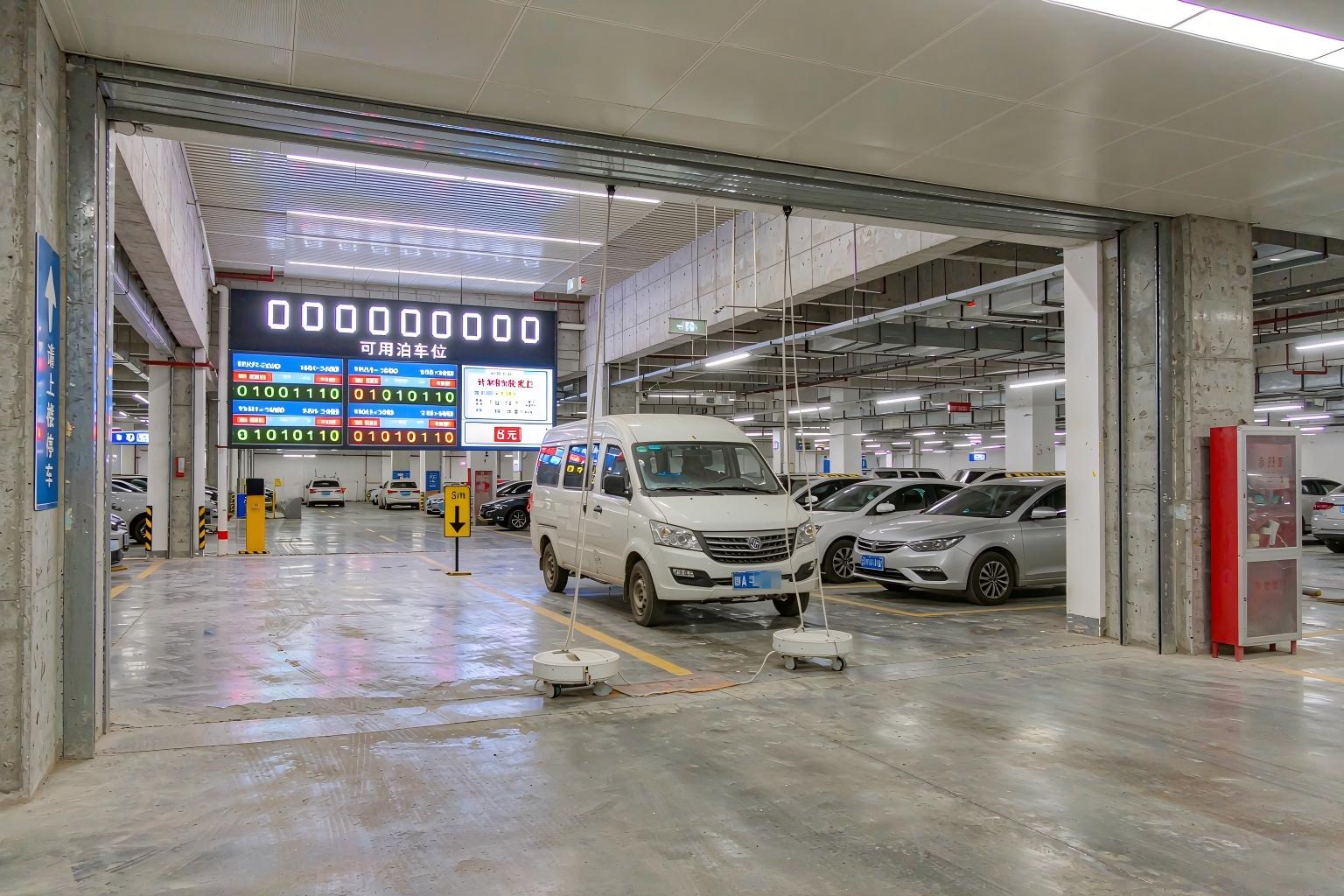
Fig. 2 — Tagged vehicles are identified at the garage lane, driving real-time bay-availability guidance and accurate billing.
Four candidate technologies compete for vehicle identification. UHF passive RFID uniquely combines long range, no battery, per-vehicle identity and low tag cost.
Technology | Read range | Vehicle fit | Limits |
Barcode / paper pass | Line of sight, <1 m | Poor — driver must stop | Easily copied, weather-sensitive, no automation |
13.56 MHz HF (NFC card) | 5–15 cm | Poor — stop and tap | Queues, driver cooperation required, card sharing |
Active RFID (battery beacon) | 50–100 m | Good range | $15–40 per tag, batteries die in 2–4 years, beacon interference |
UHF passive RFID (EPC Gen2) | 8–12 m per lane | Excellent | Requires lane antenna tuning; glass/metal mount tags needed |
• Zero-stop identification — the tag is read while the vehicle approaches at up to 40 km/h
• No battery, 5–10 year life — passive tags survive −40 °C to +85 °C, washes and sun exposure
• Vehicle-bound credential — removal destroys the tag antenna, so credentials cannot move between vehicles
• Batch awareness — one 4-port reader covers two lanes with read-zone engineering against tailgating
• Open standard — EPC Gen2 hardware is multi-vendor; tags $1.5–4.0, readers $600–2,500 per channel
Design note: UHF identifies the vehicle; cameras (ANPR) identify the plate. Mature deployments pair both — RFID for speed, plate capture for evidence (see Section 9).
The solution follows the standard four-layer RFID architecture, adapted to roadside and fleet conditions.
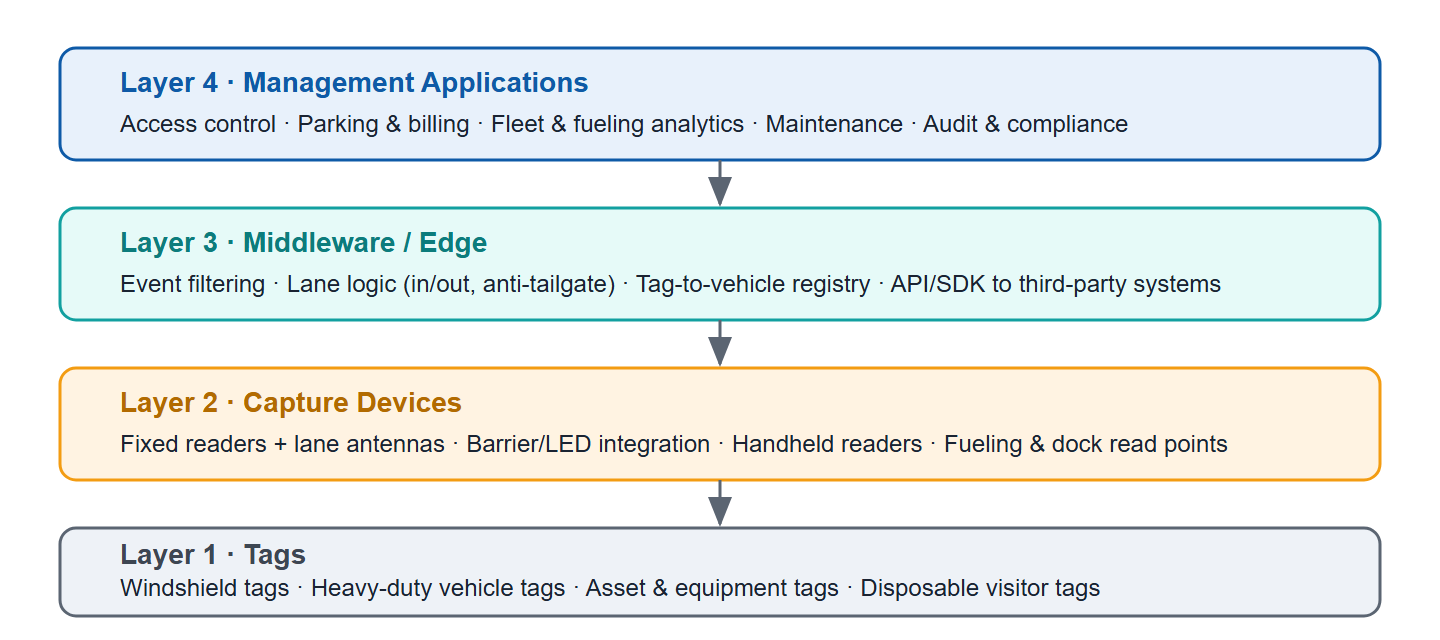
Fig. 3 — Four-layer architecture: tags → capture devices → edge middleware → management applications.
• Tags: each vehicle carries one EPC Gen2 tag encoding a unique Vehicle ID; the middleware maps EPC ⇄ plate ⇄ owner ⇄ permissions
• Capture devices: fixed readers drive circular-polarized lane antennas; handhelds cover yard audits; fueling and dock read points share the same tag pool
• Middleware: debounces duplicates, applies lane logic (direction, tailgating, allow-lists), issues barrier commands in <300 ms, and forwards normalized events via REST/MQTT
• Applications: access control and visitor management, parking billing, fleet cost analytics, maintenance workflow, compliance reporting
Availability rule: every lane runs fail-open or fail-secure by policy, and the middleware is a redundant pair — a reader outage degrades to ANPR-only, never a blocked entrance.
Vehicle identification needs tags that survive glass mounting, vibration, fuel exposure and years of sunlight. The standard portfolio has four form factors.
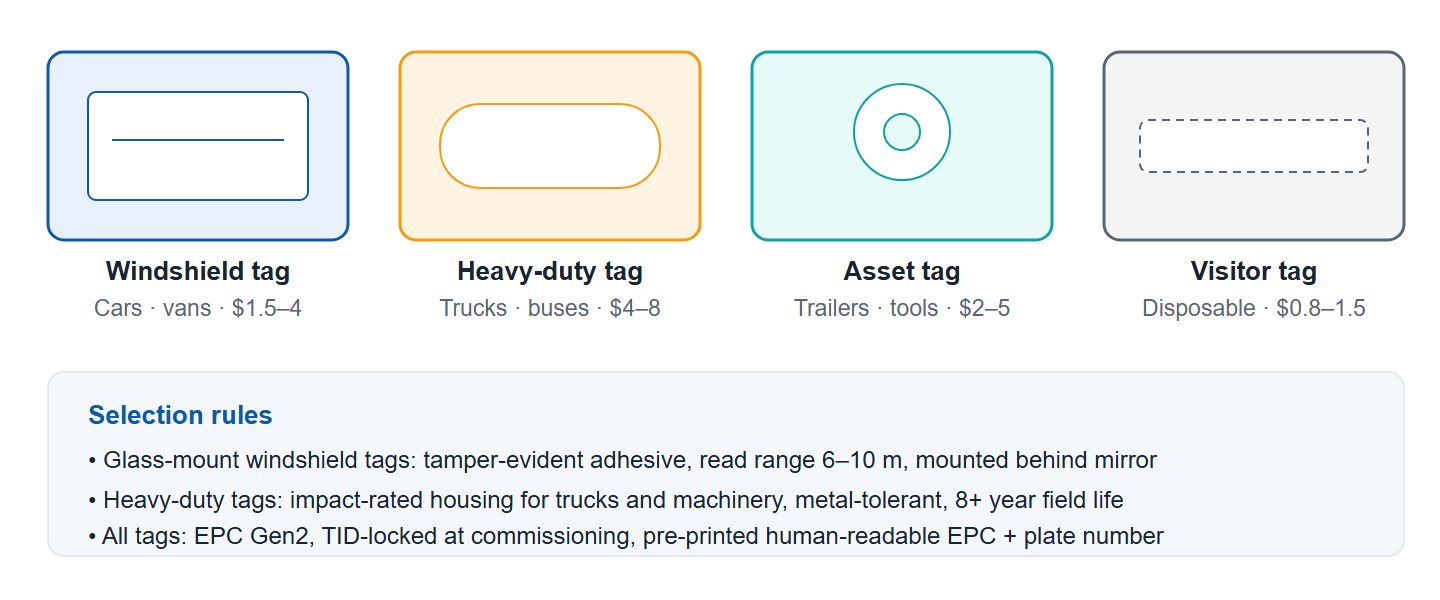
Fig. 4 — Four tag form factors and the vehicle classes each serves.
Tag class | Mounting | Read range (lane) | Unit cost | Best for |
Windshield tag (glass mount) | Behind mirror, interior | 6–10 m | $1.5–4.0 | Cars, vans, staff vehicles |
Heavy-duty vehicle tag | Headlamp / bumper / chassis | 5–9 m | $4–8 | Trucks, buses, forklifts |
Asset / trailer tag | Trailer nose, tool case | 4–8 m | $2–5 | Trailers, equipment coupling |
Disposable visitor tag | Temporary windshield | 4–7 m | $0.8–1.5 | Guests, one-day contractors |
✓ Encode only a hashed, site-scoped Vehicle ID in EPC memory; keep plate/driver/permission data in the registry
✓ Lock TID and EPC memory (kill codes reserved for decommissioning) so tags cannot be re-encoded in the field
✓ Pair every commissioning with a windshield-quality check — metallized or heated zones may need alternate mounting
✓ Log tag issue/return for visitors; auto-expire visitor EPCs after the visit window
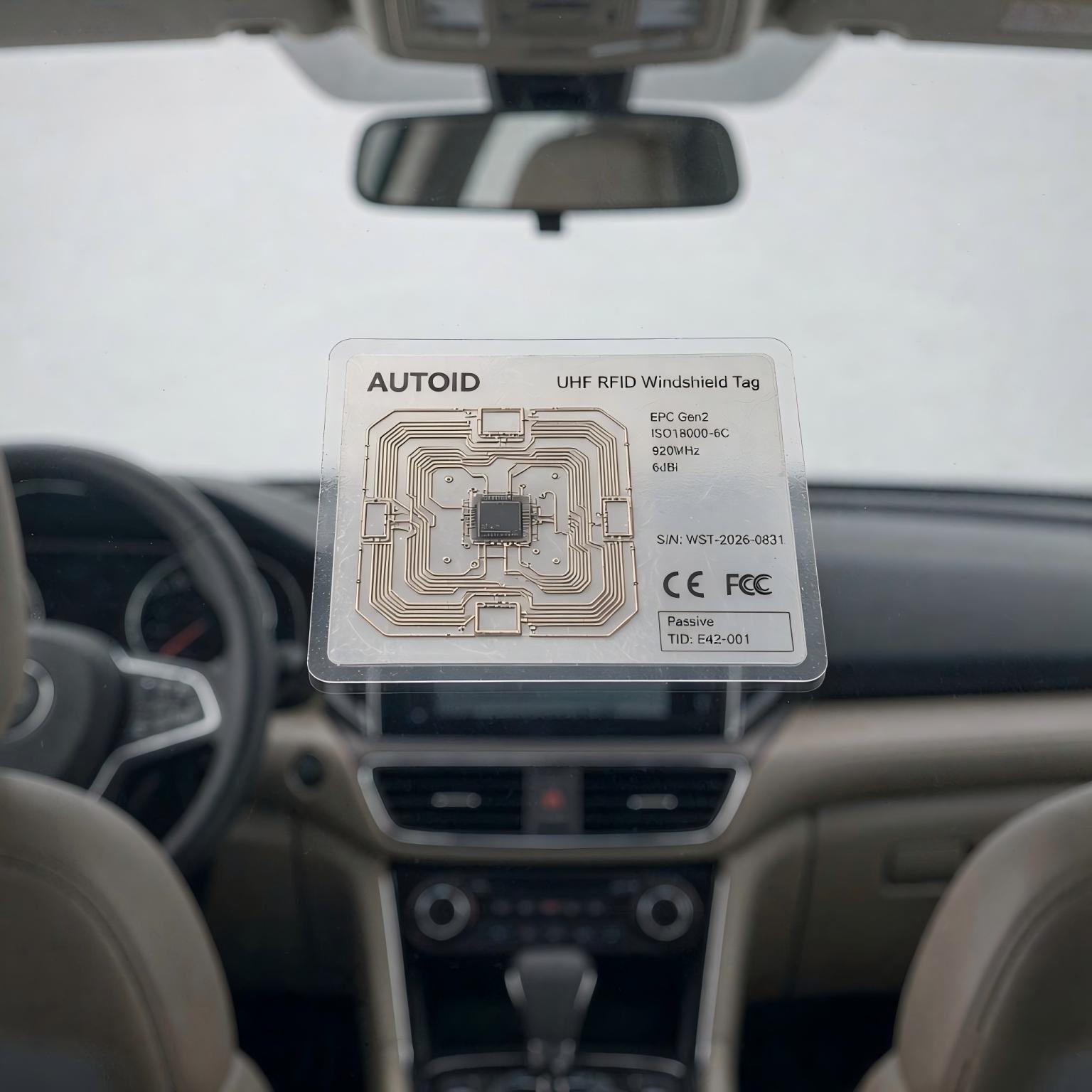
Fig. 5 — A passive windshield tag: no battery, tamper-evident, readable for 5–10 years through the glass.
Vehicle RFID succeeds or fails at the read points. Each lane is engineered as a controlled read zone with defined approach speed, antenna geometry and interference discipline.
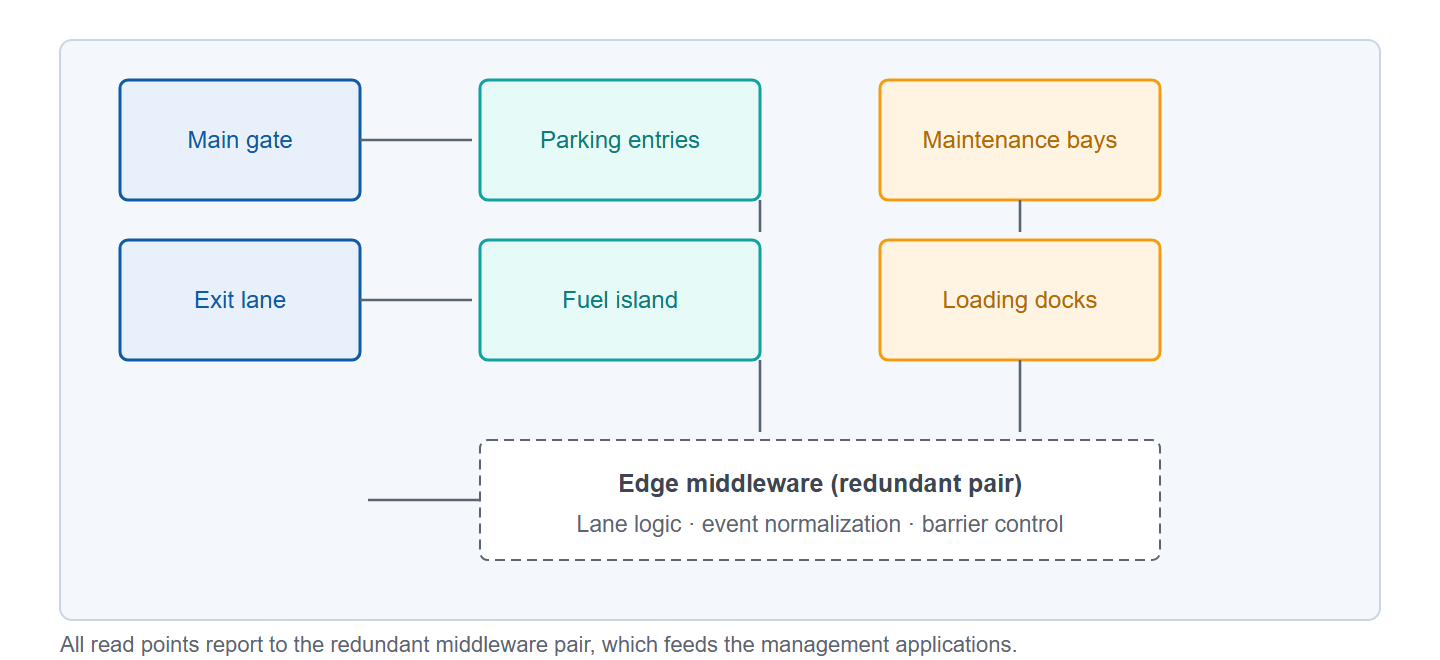
Fig. 6 — Typical site read-point map: gates, parking, fuel island, maintenance bays and docks.
Read point | Reader / antennas | Trigger logic | Integration |
Entry / exit lanes | 4-port fixed reader, 1 circular antenna per lane, overhead or roadside at 2.5–3.5 m | Continuous scan; loop detector or radar trigger for barrier timing | Boom barrier, lane LED, ANPR camera, guard intercom |
Parking entries / levels | 1–2 port reader per ramp; bay sensors | Continuous scan, dual-antenna direction | Guidance signage, billing engine |
Fuel island | 1 reader per dispenser side, antenna at 1.5–2 m | Nozzle-lift interlock — dispensing only after positive vehicle ID | Fuel system, odometer prompt, transaction log |
Maintenance bays | Fixed reader per bay or handheld | Vehicle-in event opens the work-order screen | CMMS / maintenance workflow |
Loading docks / yard gates | 4-port reader covering 2 lanes | Dock assignment + trailer tag read | Yard management / WMS |
Yard audits | Handheld UHF reader | Manual sweep of parked rows | Vehicles-on-site inventory, misuse flags |

Fig. 7 — Handheld readers audit parked fleets in minutes: hundreds of vehicles verified per sweep.
• Read zone: 6–10 m of reliable detection before the barrier stop line; approach speed ≤ 40 km/h (≤ 15 km/h in tight urban lanes)
• Antenna aim: circular polarization covers tag heights 0.5 m (motorbike) to 2.2 m (truck cab); tilt 10–15° toward the approach lane
• Adjacent-lane isolation: ≥ 3 m separation or RF-absorbing dividers; verified during the site survey
• Tailgating control: one-vehicle windows using loop detectors; a second EPC inside the window raises an alarm
• Failover: every lane pairs RFID with ANPR + manual override; the guard console shows the last 5 reads per lane
One tag identity drives five operational workflows, each described as trigger → system action → outcome.
Trigger: vehicle enters the lane read zone. Valid EPC → barrier opens and lane LED turns green in under 1 second; unknown or invalid → barrier stays closed, ANPR snapshot and alert go to the guard console. Every event is logged with lane and timestamp.
Trigger: tagged vehicle passes a parking entry or level read point. The parking engine opens a session keyed to the Vehicle ID; monthly parkers validate automatically and visitors route to pay-on-exit. Outcome: accurate per-vehicle billing, no pass sharing, exit in <2 s.
Trigger: nozzle lifted at the fuel island. The dispenser interlock requires a positive vehicle read — every liter is attributed to a verified vehicle, and mismatched or missing tags block dispensing and raise an alert. Fuel-card sharing and phantom fueling are eliminated.
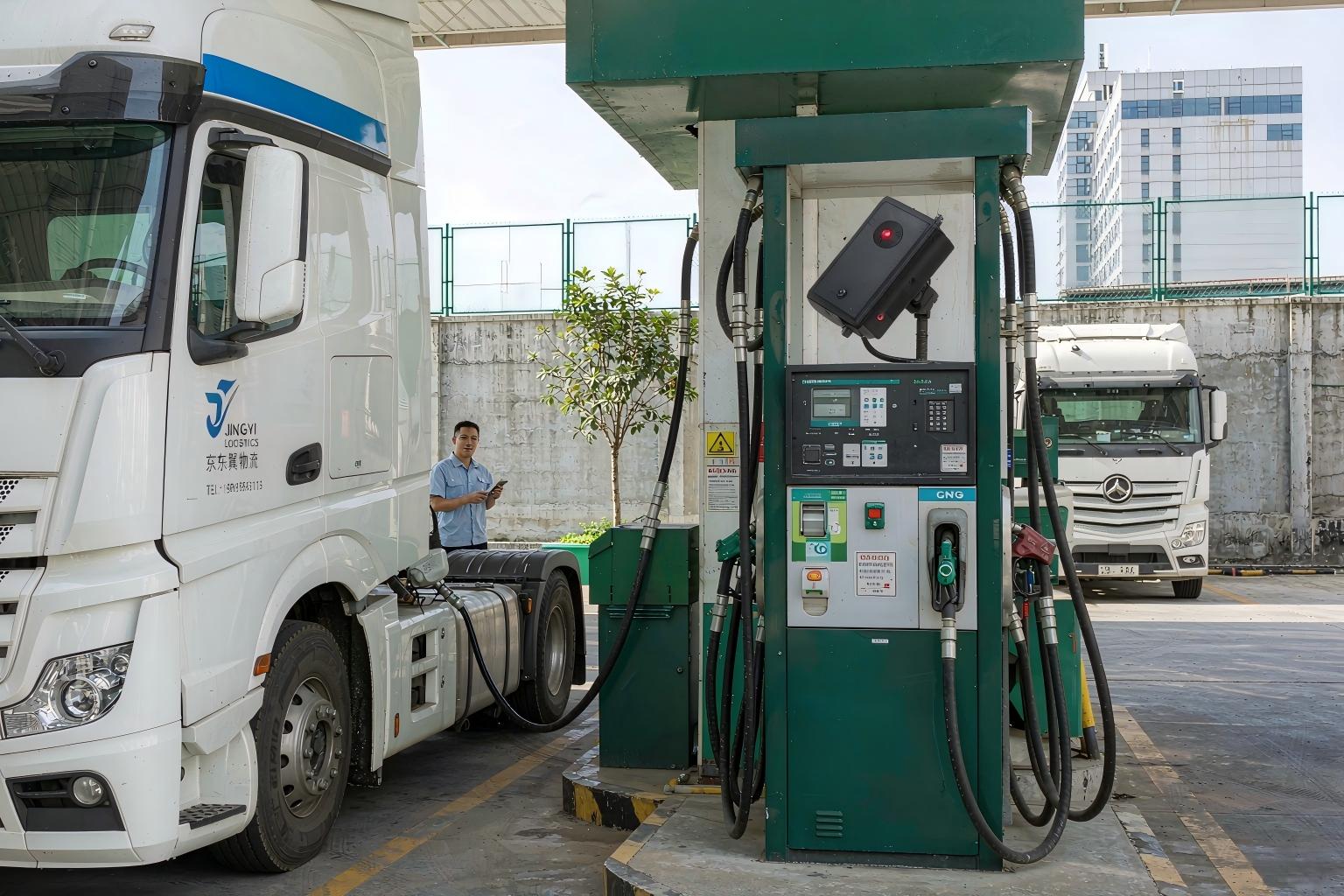
Fig. 9 — Fuel dispensing unlocked only by a verified vehicle ID — cost control at the point of spend.
Trigger: vehicle enters a maintenance bay. The CMMS opens the vehicle's service history and due items; completed work orders close against the same verified ID, and insurance/safety-check reminders fire automatically.
Trigger: scheduled handheld sweeps and continuous gate logs. The middleware reconciles vehicles present vs. vehicles authorized, flags overnight stays, weekend movements and impossible travel between gates — misuse detected within hours instead of month-end.
Scenario | Primary read points | Key value |
Corporate / government campus | Main + staff gates, visitor lane, basement parking | Queue-free rush hours, visitor automation, security audit trail |
Residential community | One entry/exit pair, parking levels | Resident convenience, dispute-free visitor billing |
Logistics hub / 3PL yard | Yard gates, dock doors, fuel island, maintenance | Trailer dwell-time KPIs, fuel control, yard visibility |
Municipal / toll-like lanes | High-speed lanes (60+ km/h) | Non-stop throughput, tag + plate dual read |
Fleet depot (bus / delivery) | Depot gates, wash bay, fueling, maintenance | Dispatch accuracy, fuel discipline, maintenance compliance |
• Barrier and lane hardware: relay/IO or TCP control to boom barriers, lane LEDs, traffic lights; loop detectors define barrier windows
• ANPR cameras: RFID is primary, plate capture is evidence — “tag says plate X, camera sees plate Y” triggers a tamper alarm
• Parking and billing: session open/close events via REST; payment terminals post against the Vehicle ID session
• Fleet / fuel / CMMS: fuel dispensers and maintenance systems consume Vehicle ID events; odometer and driver data merge into analytics
• Security / PSIM: alarms, watch-lists and video wall pop-ups on rejected reads
• Data warehouse: normalized event stream (EPC, lane, direction, timestamp, result) retained 2–5 years for audits
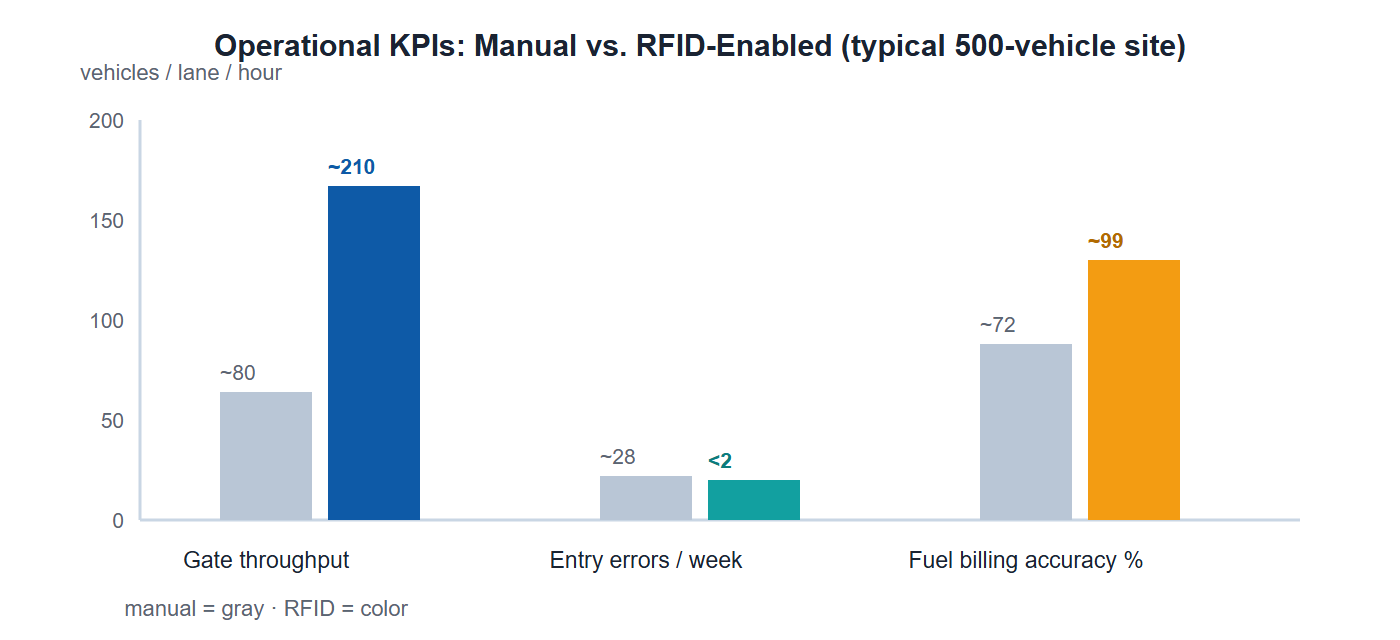
Fig. 10 — Typical KPI movement after RFID enablement (illustrative, calibrated from published deployment ranges).
KPI | Manual / card-based | UHF RFID target |
Lane throughput (vehicles/hour) | 60–90 | 180–250 |
Vehicle identification time | 15–40 s (stop) | < 1 s (moving) |
Entry/exit record completeness | ~70–85% | 100% automatic |
Read accuracy per lane | — | ≥ 99.9% |
Fuel cost attribution accuracy | ~70% | ≥ 99% |
Parking revenue leakage | 10–20% | < 1% |
Audit preparation time (monthly) | 2–4 days | < 2 hours |
Reference model: a corporate campus with 2 vehicle gates (4 lanes), 500 staff vehicles, 200 monthly parkers, plus a 60-vehicle logistics fleet sharing the same tag pool.
Item | Qty | Unit cost | Subtotal |
4-port fixed readers | 6 | $1,400 | $8,400 |
Lane antennas (circular polarized) | 10 | $450 | $4,500 |
Handheld readers | 2 | $1,900 | $3,800 |
Middleware licenses + server | 1 | $9,000 | $9,000 |
Integration (barriers, ANPR, fuel, CMMS) | site | — | $12,000 |
Tags: 700 permanent + 1,200 visitor/yr | — | avg $2.5 | $4,750 |
Total initial investment | ≈ $42,500 | ||
Annual running cost (support, tags, connectivity) | ≈ $5,000 |
• Guard-hour savings: ≈ $38,000/yr (staff redeployed to value tasks)
• Parking revenue recovery: $14,000/yr (leakage + visitor billing accuracy)
• Fuel cost reduction (60-vehicle fleet): $9,500/yr at 8–12% savings on a $95k fuel budget
• Maintenance and dispute reduction: $6,000/yr
Total annual benefit ≈ $67,500 → payback ≈ 10–16 months including running costs. Sensitivity: payback is driven by number of automated lanes, local guard cost and fleet fuel budget; access-control-only sites typically see 16–24 months.
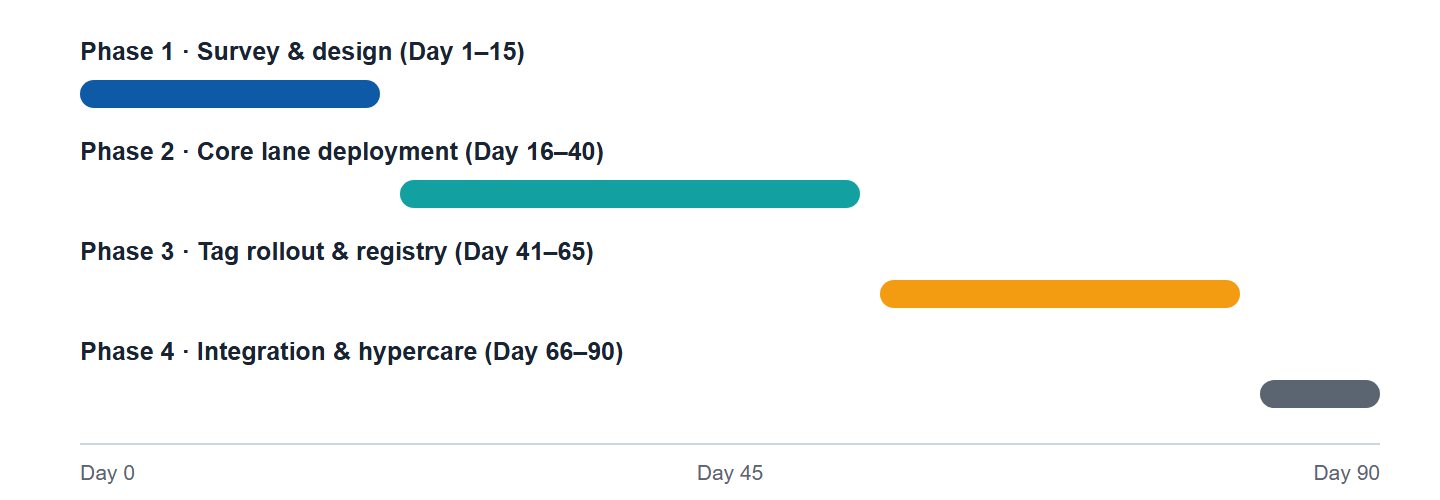
Fig. 11 — Four phases, 90 days to full operation.
Phase | Days | Key activities | Exit criteria |
1. Survey & design | 1–15 | RF site survey per lane; traffic count; barrier/ANPR inventory; tag mount audit on 20 sample vehicles | Signed lane design; read-rate simulation ≥ 99.5% |
2. Core lanes | 16–40 | Install readers/antennas; tune power and dwell; integrate barriers; middleware pair live | Pilot lane ≥ 99.9% read on 300 consecutive vehicles; barrier latency < 1 s |
3. Tag rollout | 41–65 | Commission tags in batches; registry import; visitor-tag process; driver communication | ≥ 95% of eligible vehicles tagged; registry 100% reconciled |
4. Integration & hypercare | 66–90 | Parking/fuel/CMMS integration; handheld audits; KPI dashboards; 2-week hypercare | All workflows live; KPI baseline captured; handover to operations |
Risk | Mitigation |
Adjacent-lane cross reads | Antenna isolation survey, per-lane power plans, one-vehicle windows with loop detectors |
Metallized / heated windshield zones | Mount-position audit in Phase 1; alternate headlamp or bumper tags for affected vehicles |
Tag cloning concern | TID-locked tags, tag-plate-ANPR cross-check, anomaly alarms on impossible movements |
Reader outage | Redundant middleware, ANPR fallback mode, spare-reader pool (1 per 5 deployed), guard override console |
Visitor tags not returned | Auto-expiry in registry, deposit process, disposable tag cost already modeled |
Read-rate decay over time | Quarterly lane health checks: golden-tag test per lane, antenna re-tune, firmware review |
Ongoing operations: a site health dashboard tracks per-lane read rate, barrier latency and alarm counts; a 15-minute golden-tag test per lane weekly catches drift before drivers complain. Data retention follows local regulations (typically 2–5 years for vehicle movement logs; privacy review required where driver identity is stored — GDPR or local equivalents).
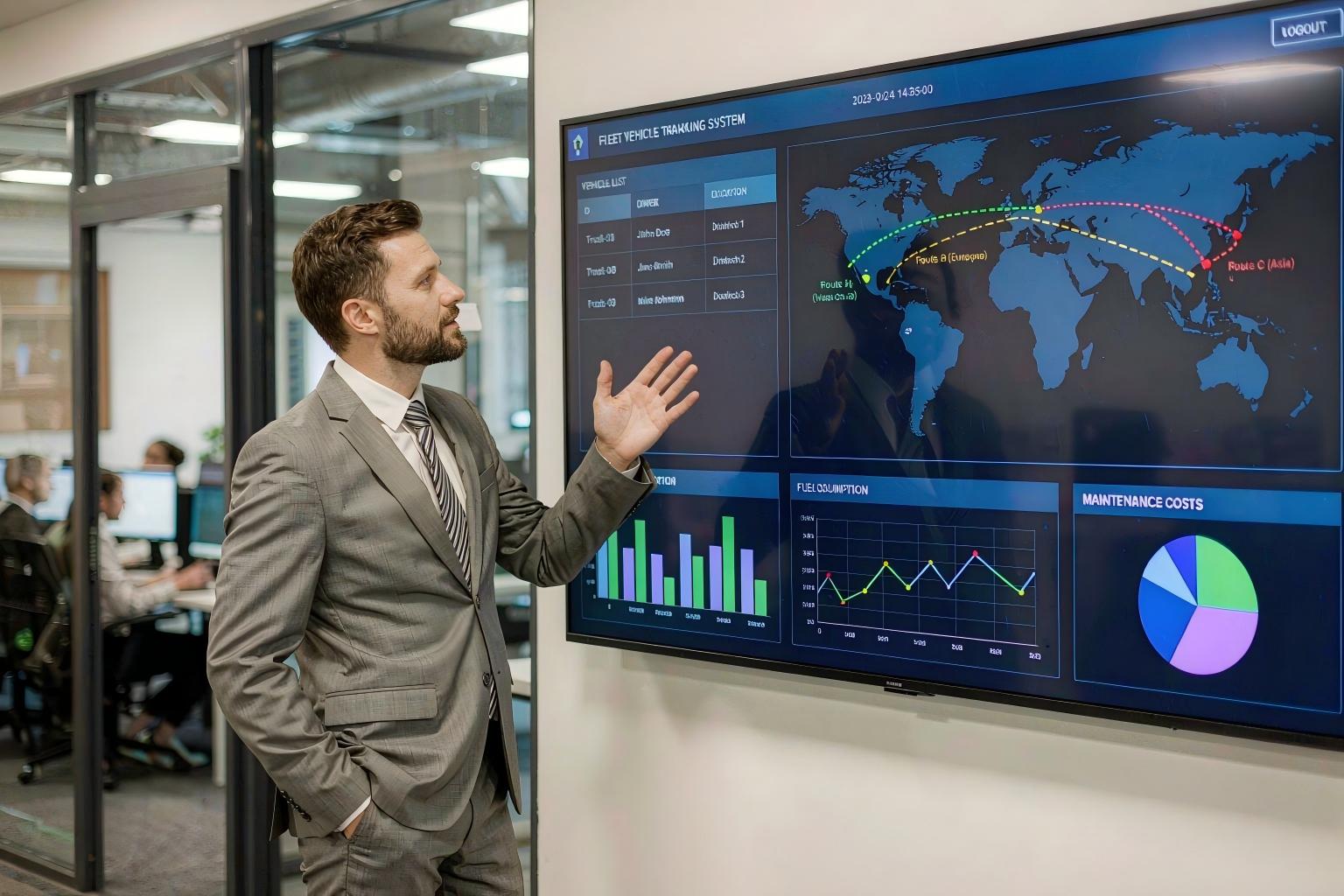
Fig. 12 — The end state: one operations view of gate events, parking occupancy, fuel spend and maintenance compliance.
Most windshields are RF-friendly, but metallized films, some heating grids and certain tint bands attenuate UHF. The Phase 1 mount audit on 20 sample vehicles per site identifies exceptions, which receive headlamp- or bumper-mount heavy-duty tags instead.
The lane stays closed, the ANPR camera captures the plate, and the guard console prompts a manual decision (visitor tag issue, temporary pass, or deny). Visitor and contractor vehicles can be pre-registered with disposable tags.
Yes — 4-port readers typically drive two lanes (2 antennas each). The middleware separates lanes by antenna port and applies independent logic per lane.
ANPR is camera-based plate reading: strong as evidence, but accuracy drops with dirt, glare and non-standard plates. UHF RFID is faster and more stable in all weather; combining both gives speed plus tamper evidence.
Motorbikes read reliably with properly aimed antennas (tag height range 0.5–2.2 m). Forklifts and heavy machinery use heavy-duty housing tags; trailers carry asset tags read at yard gates and docks.
Passive tags last 5–10 years with no battery. Replacement is a registry re-issue: the old EPC is killed and the new EPC inherits the vehicle profile in minutes.
Ready to Eliminate the Queue at Your Gate?
This plan converts vehicle identification from a manual checkpoint into an automatic, auditable data stream. Start with a 2-week pilot: one lane, 50 vehicles, one barrier integration — exit criteria of ≥ 99.9% read accuracy and < 1 s barrier latency before scaling site-wide.

Scan To Add

Scan To Add
Copyright © 2026 Shenzhen Zhishun Information Technology Co., Ltd All Rights Reserved.
Technical Support:SYSX





 182-7997-4925

 Home